




Dear Investor,
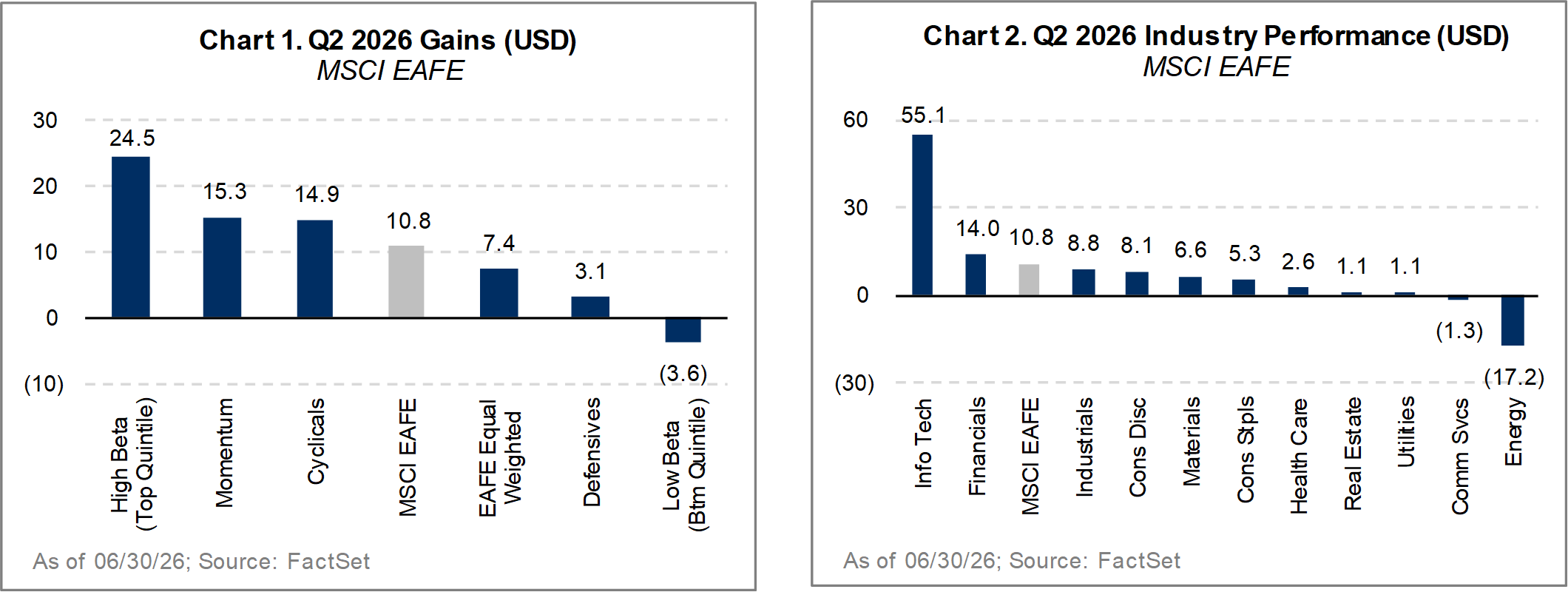
The Altrinsic International Equity portfolio gained 8.7% gross of fees in the second quarter (+8.5% net), as measured in US dollars. Concerns surrounding commodity inflation and Middle East tensions gave way to AI optimism and a related surge in semiconductor demand, fueling a 10.8% rise in the MSCI EAFE Index.i As seen in Charts 1 and 2, high-beta and momentum factors led markets, while sector leadership came from technology companies, cyclical banks, and a narrow set of industrials tied to AI infrastructure. In fact, half the benchmark’s gain came from just 20 AI-related infrastructure stocks, out of a universe of nearly 700. Our underweight to these areas, combined with weakness in our non-bank financial holdings, weighed on relative performance. The AI story has crowded out a broad set of companies trading at meaningful discounts to both the market and their own fair value – and it is here that we find the most compelling risk-reward.
Perspectives
AI is the most transformative technology seen in generations. Excitement surpasses that surrounding the internet (2000), autos (early 1900s), electricity (1890s), and railroads (1850s). Headlines and commentary, with profound “outlooks” by luminaries, proliferate, while trillion-dollar IPOs are foregone conclusions. Considering the prevailing exuberance surrounding anything AI-related, and the disinterest in most other areas of the market, it was timely and essential to get on the road throughout Asia, Europe, and the Americas to refresh our “ground floor” perspectives. We visited our existing investments and new candidates, including those on the forefront of AI and in essential supply chains; venture capitalists, early-stage disruptors, regulators, and government officials; and a range of thoughtful people in our network.
AI infrastructure was a key area of focus. The largest hyperscalers are locked in an arms race, while leading foundational model companies continue to attract capital at extraordinary valuations. As a result, companies across the AI value chain delivered significant returns during the quarter, as rapidly rising demand created bottlenecks and drove profitability sharply higher. Aggregate AI-related capex is now a greater percentage of GDP than any prior infrastructure boom. Morgan Stanley estimates that capital investment by five large AI hyperscalers will average $1.1 trillion annually from 2026 through 2028, compared with the US Department of Defense’s $961 billion budget request for fiscal year 2026.1 Based on our company engagements, spending plans over the next two years are highly visible. The more difficult questions are what happens beyond that horizon, how much of today’s supernormal profitability in the supply chain will prove defensible, and when stock prices will reflect greater long-term uncertainty.
Several considerations inform our view:
- Enterprise AI customers are becoming more disciplined. The conversation has shifted from spending at any price to demonstrating a return on investment, while addressing security, governance, and data protection. At the same time, lower-cost ‘good-enough’ models are proliferating. This matters because leading AI model companies are among the largest drivers of infrastructure demand, but they have yet to demonstrate durable pricing power or strong barriers to entry.
- Competition is returning to a consolidated industry. The semiconductor ecosystem has consolidated over several decades as technological complexity and development costs increased, while funding for innovative startups declined. However, today’s high returns are attracting capital and competition. China’s CXMT and YMTC have become meaningful competitors in DRAM and NAND, respectively, and substantial additional capacity is planned. These companies already hold about 10% of the global DRAM market share with massive new capacity that could double that in the next five years. Additional supply-side response is coming from venture capital-backed entrants, as well as customers who are investing in custom silicon and alternative architectures to reduce their dependence on high-cost third-party components. The magnitude of this cycle may exceed prior ones, but we believe it will be difficult to escape fundamental economic laws.
- High semiconductor prices crowd out demand from legacy users. AI still accounts for a minority of demand across much of the semiconductor industry, while rising memory and component costs are feeding through to device prices. Industry forecasts now call for double-digit declines in both smartphone and PC shipments in 2026. Higher prices can lift profits temporarily, but they also encourage buyers to defer purchases, redesign products, and seek lower-cost alternatives.
- Expectations leave little room for disappointment. Historically, semiconductor companies delivered growth above GDP while earning mid-teens net profit margins. Current valuations require sales growth, profitability, and capital spending at roughly three times historical norms, allowing them to retain an outsized share of the technology sector’s profit pool. That is a demanding hurdle, particularly in an industry where high returns have historically attracted new capacity and competition.
Enthusiasm for the infrastructure value chain has expanded alongside the spending, making it increasingly important to distinguish technological promise from investment opportunity. As discussed in recent quarters, we see the greatest long-term opportunities among AI adopters using the technology to improve growth, efficiency, and returns, rather than among suppliers whose valuations require today’s bottlenecks and peak margins to persist.
Several additional themes emerged during our meetings, ranging from Japan’s evolving corporate priorities to divergent approaches to AI adoption to encouraging capital markets reform in Europe. More broadly, these trips reinforced our view that structural change is underway, though the pace of change varies by region and sector, creating pockets of risk and opportunity.
When we first traveled to Japan in the early 1990s, Japanese stocks represented approximately 30% of the MSCI World Index (versus about 6% today), and the Emperor’s palace was worth more than the state of California. We watched the real estate bubble inflate, the subsequent deflation, and the ‘lost decades’ until, more recently, a meaningful if uneven transition from a country of unrealized potential to one of improved financial productivity emerged. Global competition, sustained inflation, and labor scarcity are gradually reshaping corporate behavior, with management teams placing greater emphasis on price-mix, cash flow, and portfolio optimization rather than growth for growth’s sake. While the country remains slow to adopt AI, industrial companies such as Murata Manufacturing and SMC Corporation occupy strategic positions within the global AI and automation ecosystems. Companies such as Sony have greatly enhanced strategic focus, capital allocation, and core competitive advantages in entertainment (music and gaming) and image sensors. Positive change remains highly company-specific, reinforcing the value of bottom-up security selection in a market where approximately 29% of Japanese companies still trade below book value.
Our discussions across China reinforced a more nuanced picture than prevailing sentiment suggests. Consumer confidence and property market activity remain subdued, but the drag from both appears to be moderating. Stability in the property market is key, considering both household wealth and, to a lesser extent, local government revenues depend on it. At the same time, policy and regulation play a bigger role in shaping competitive dynamics, rewarding scale and compliance. Perhaps most striking was the extent to which AI has become a national priority, with companies across industries actively investing to accelerate adoption. We expect China to continue to be a low-cost provider across industries but with the greatest impact in semiconductors, batteries, electric vehicles, and industrial automation. We believe the potential to disrupt the current market narrative relating to AI infrastructure and closed-loop AI models is underappreciated.
Europe has struggled to evolve from a confederation of independent states to a true European Union. However, we were positively surprised by the efforts and progress being made to simplify capital markets regulation and advance the European Savings and Investment Union (SIU). The SIU aims to reduce cross-border regulatory complexity and provide tax incentives to encourage households to invest large cash stockpiles in equity investments. This serves the dual purpose of providing investment capital and supporting valuations, which is no small matter. Europeans hold twice as much of their assets in cash as Americans, equivalent to nearly $7 trillion.2 Apart from the macro considerations, our exchange investments, Deutsche Boerse and Euronext, would see a strong boost to their market infrastructure businesses if the SIU incentives incite action.
Elsewhere in Europe, we have seen an increase in takeover activity and speculation among a growing number of our investments. Given their blend of attractive valuations, strong balance sheets, and solid and/or improving fundamentals, we expect this trend to continue. A backdrop of abundant liquidity, PE firms with significant dry powder, and strategics seeking value-accretive growth is supportive.
Travel has always been instrumental to our investment process, and we will continue to share our findings in future letters and through our ‘Notes From the Road’ series.
Performance Attribution and Investment Activity
During the quarter, benchmark returns were concentrated in a narrow group of higher-beta cyclical stocks, notably AI-related infrastructure and banks. Our underweight exposure to such characteristics – instead favoring quality, durability, and value – weighed on relative results.
From a sectoral perspective, investments in financials (Deutsche Boerse, Willis Towers Watson), consumer discretionary (BMW, Alibaba), and health care (Medtronic, GSK, Sanofi) lagged this quarter. Investments in industrials (Intertek) and communication services (Informa), as well as our underweight exposure to utilities, were sources of positive attribution.
The portfolio’s focus on asset-light, less cyclical financials franchises lagged a sharp rally in economically leveraged banks. Deutsche Boerse and Willis Towers Watson were not immune, as they faced decelerating volatility and slowing end-market premium growth, respectively. Both companies operate cash-generative businesses that benefit from an increasingly volatile world, and alongside strong management teams, should consistently compound earnings over time.
Adidas investors are starting to appreciate that the company is more than a World Cup play, benefiting our relative performance in consumer discretionary. While the World Cup has been hugely popular and a welcome boost, the company also has a balanced portfolio of running, training, and lifestyle products. Adidas’ gains were offset by weakness in BMW and Alibaba. BMW shares fell after management lowered guidance due to restructuring costs and continued weakness in China, but we expect improving operating leverage and returns as the company transitions to its Neue Klasse product line. Alibaba underperformed amid elevated AI investment spending and a softer Chinese consumer, despite continued cloud growth and AI monetization that we believe strengthens its long-term earnings power.
Medtronic weighed on health care performance as it faced inflation headwinds and normalizing procedure volumes. The company’s stronger post-COVID supply chain, formidable new product pipeline, and resilient end market fundamentals provide several pathways for value creation. GSK and Sanofi weighed on health care performance as they faced growth concerns, but we see great potential for new CEOs in both companies to accelerate drug development, which should defend their leading positions in respective therapies.
The industrials and communications sectors were buoyed by Intertek and Informa, respectively. Intertek rallied after the company agreed to EQT’s takeover proposal, highlighting the attractive growth and cash flow characteristics of the testing, inspection, and certification (TIC) sector. Informa benefited from easing Middle East tensions, while strong global growth reinforced our view that the company’s transformation into a global B2B events leader will drive higher long-term growth and profitability.
During the quarter, we initiated positions in five companies (Airbus, Intact Financial, Kingspan, Octave Intelligence, TE Connectivity) and exited two holdings (Agnico Eagle, Akzo Nobel).
Netherlands-based Airbus is entering multi-year demand cycles in commercial aerospace and European defense spending with pent-up operating leverage, highly desirable aircraft models, and a strong execution track record. We believe Canada’s Intact Financial is one of the best-run insurance companies and expect it will sustain competitive discipline and reap benefits from technology investments and portfolio pruning. Kingspan, an advanced building products manufacturer based in Ireland, is making notable progress in expanding market share in an otherwise depressed construction environment. Swedish Octave Intelligence owns a collection of high-quality industrial software franchises and is improving its cost base following its spin-off from former parent Hexagon AB. TE Connectivity is the world’s largest electronic connector manufacturer. Fears that new optical technology will displace its copper-based data center products have weighed on the stock, but increased power requirements increase the need for its components and are an underappreciated opportunity.
We sold our position in Agnico Eagle as the shares re-rated to reflect the company’s strong operating performance, while elevated gold prices reduced the metal’s historical downside protection. We exited our investment in Akzo Nobel after stock price gains following two formal acquisition offers. The company has since elected to pursue a complicated merger with its peer Axalta.
Closing Thoughts
Structural change is underway across the global economy, with the most compelling investment opportunities in underappreciated corners of the market often overlooked amid the enthusiasm for all things AI. Many popular segments, where valuations depend on today’s bottlenecks persisting indefinitely, present an increasingly negative risk-return tradeoff. Instead, we continue to find attractive opportunities among companies compounding value through underappreciated strong and/or improving fundamentals. As always, we thank you for your continued partnership and trust.
Sincerely,
John Hock
John DeVita
Rich McCormick