



Let China sleep, for when she wakes, she will shake the world.
– often attributed to Napoleon Bonaparte
We recently returned from Hong Kong, Shenzhen, and Shanghai, three legs of a 55-meeting research trip across Asia. Our China diligence led us into company meetings across the technology, consumer, and financials sectors and onto BYD’s campus and robotics production floors. In the interest of thoroughness, we also prioritized a firsthand audit of Yum China’s fried chicken.
While much attention is focused on the tech-driven markets of South Korea and Taiwan, this trip allowed us to investigate more deeply companies where leading-edge technology is already applied and monetized, helping them gain market share. China remains one of our richest opportunity sets and accounts for 23% of our Emerging Markets Opportunities portfolio.1 At this level, we are overweight – but remain highly selective.
Our 4Q 2024 letter invoked ‘Run of the Red Queen’ – China running fast just to stay in place. While on the ground in China, we wanted to stress-test how much the country had truly evolved since then. With the country’s “DeepSeek moment” already in the rearview, this trip confirmed – vividly – that it is no longer the right frame of reference. China is not chasing anymore. It is leading through process, efficiency, and speed.
Most of our conversations with local investors centered on AI, and the mood was unmistakably proud. Narrowing model gaps, open-source momentum, and measurable returns are drivers. The same pattern kept resurfacing in boardrooms, on factory floors, and in conversations about frontier LLMs. AI is everywhere, and the companies converting it into returns are those with process knowledge – iterative, hands-on expertise – that compounds over time.
China Consumer: Resilience is Selective, Not Systemic
Common prosperity is visible in the service experience. Everything is at one’s fingertips, from high-speed trains and modern airports to visa-free entry2, frictionless customs, and even Yum China (KFC) orders. As consumers, we were impressed. As investors, we are more circumspect; when convenience arrives through a massive government drive, high-quality and sustainable returns are hard to find. Beijing’s anti-involution campaign3 increasingly looks like a correction to an industrial policy that expanded supply too well. Companies are now trying to earn a viable return inside that correction.
The consumer backdrop remains challenging. We noticed lighter attendance at an investor conference we joined during part of our trip, cautious questioning, and a pattern of management teams defending resilience rather than promoting growth. Pressure is most acute in goods, where entrenched deflation expectations delay discretionary purchases. Services seem to be the exception. Quick-service restaurants, travel, and lodging show resilient traffic, better execution, and selective margin improvement. Yum China was the most constructive of our over 10 consumer diligence meetings – growth there depends more on format innovation and execution than macro recovery, and it remains an earnings compounder with a 100% free cash flow return commitment.
AI Has Become a Strategic Board-Level Priority
AI dominated the agenda in nearly every management meeting across the landscape, not just within technology. Chairmen were visibly focused on not falling behind, with strategies set, agents deployed, and investors demanding exposure. Conversations explored economics, from costs and payback timelines to client ROI. This experience contrasts with reports from our colleagues’ recent travels through Europe and Japan, where AI remains a strategic consideration, but management teams are often light on details.
AI enablement also extends well beyond technology companies. At Yum China and Goneo Group, an electrical component manufacturer, AI agents run the customer experience while smart products drive price uplift. In edge AI industries like robotics, data leadership delivers quantifiable ROI for industrial customers. Upstream, Chinese LLMs’ efficiency and open-source distribution are accelerating adoption. We believe China has room to win with AI well beyond technology, but Western policy intervention and LLM price competition remain key variables.
Converting AI into Returns
Chips are moving fast, memory is scarce, and AI demand is shifting in real time. After four days in Shenzhen, one pattern stood out: across autos, robotics, handsets, and AI infrastructure, only a small group of Chinese companies is converting AI momentum into durable high-margin growth, often in overlooked and/or unloved areas.
In AI infrastructure, traditional server players are profitably expanding their addressable markets, evolving from hardware makers to infrastructure providers. Lenovo’s AI revenue is growing almost 80% with record server and storage sales. We saw some of their servers live in Indonesia the week before, which made the pivot tangible.
In autos, applied AI helps companies take share as the sector commoditizes. BYD is pulling ahead, with flash-charging batteries, in-house autonomous-driving chips, and next-generation energy storage already in use. The strategy has shifted toward higher-margin drivers, including global expansion, commercial EVs, and monetizing battery technology.
In handsets, AI-driven premiumization cushions margin pressure from rising memory costs. Companies we own across Africa and ASEAN are outperforming, partially by moving upmarket. Shenzhen Transsion, the world’s fifth-largest handset maker, grew unit prices 30% year over year to offset memory cost pressures.

Three Points on Robotics & Physical AI
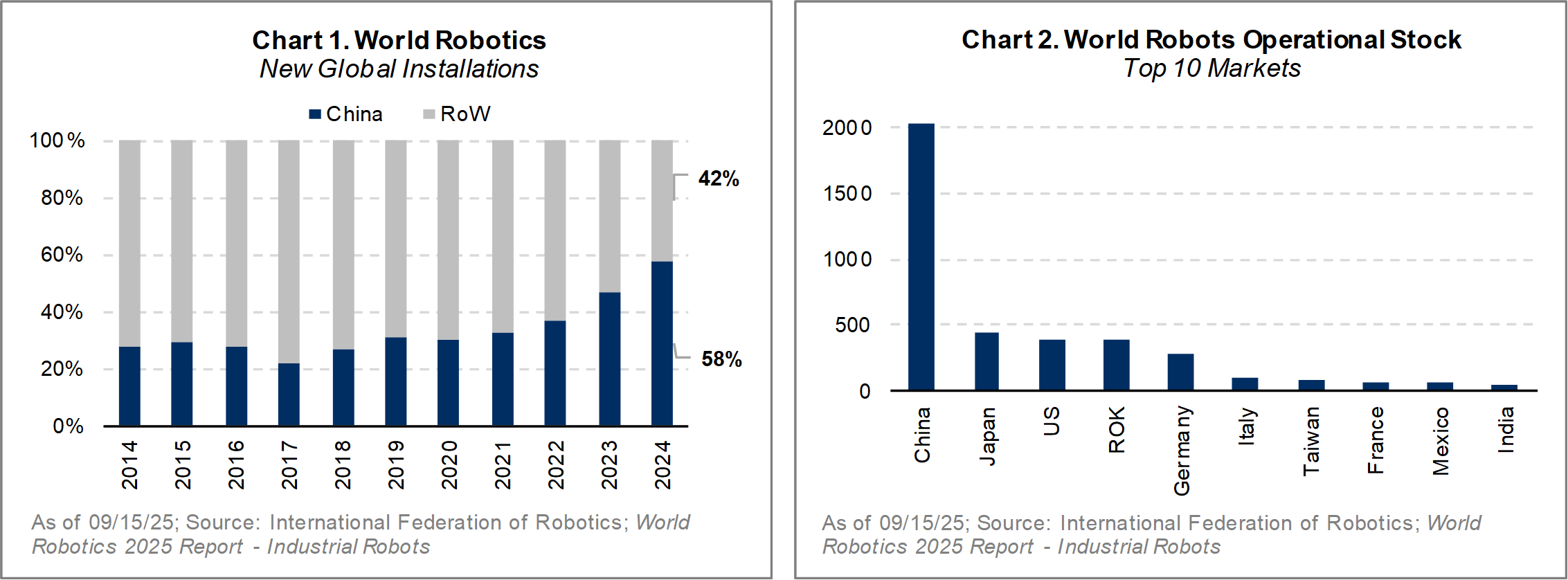
China is now the global leader in robot installation, doubling its global market share over the last decade (Chart 1) and surpassing Germany and Japan (Chart 2).
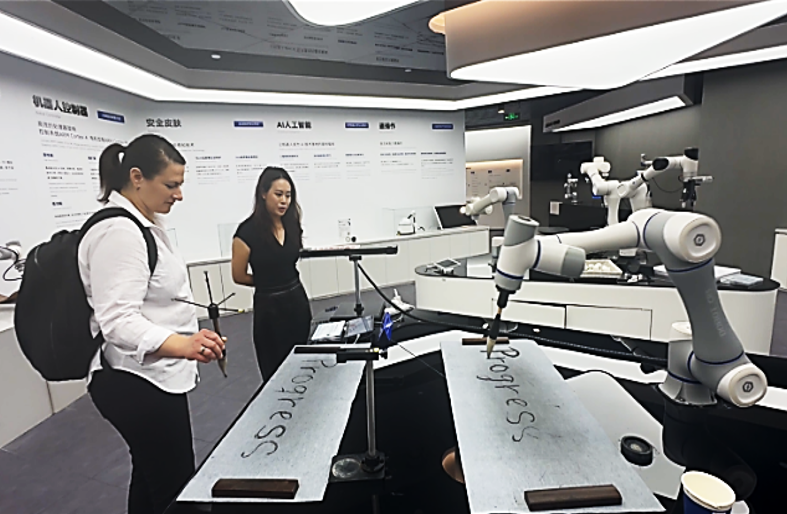
Against that backdrop, we met two of the sector’s leaders – one in cobots,4 one in humanoids – first at a conference in Hong Kong and then in their corporate offices in Shenzhen. Three advantages stood out:
- The data moat – Two to three years of deployment data inside automakers like Geely and BYD is compounding into a training advantage that no greenfield competitor (including Tesla, which is likely still years from a meaningful China entry) can replicate in the near term. More robots deployed means more data compounding.
- Unit economics are inflecting; free cash flow milestone is still ahead – Humanoid bill-of-material5 costs are falling fast, which is expanding margins and shortening ROI. Clients can now recoup a robot’s cost in under two years and simultaneously benefit from labor savings. One of the leaders we met guided to EBITDA-positive next year; the other is already profitable in cobots, with roughly 13% global share. But scaling into durable earnings is the debate.
- Global expansion separates the winners – Tariffs look manageable given domestic sourcing, but Western trust gaps and a capital disadvantage versus Tesla’s Optimus are the medium-term test. A strong IPO pipeline, including an NVIDIA-endorsed domestic player, is lending new credibility.
We are not yet directly invested in the robotics sub-sector, but the demand signal is no longer hypothetical. Our clearest proof came from our cross-border engagement with a Polish retailer’s Shanghai-based procurement team; they told us their CEO’s recent China trips included visits to robotics companies, and the company has already purchased robots for deployment across several countries. The data moat validates our process-knowledge thesis, but our discipline requires proven and sustainable free cash flow. We will continue to closely track developments in this industry and stand ready to invest once financial productivity and other economics clear our bar.
Frontier LLM Models: Pride Backed by Performance
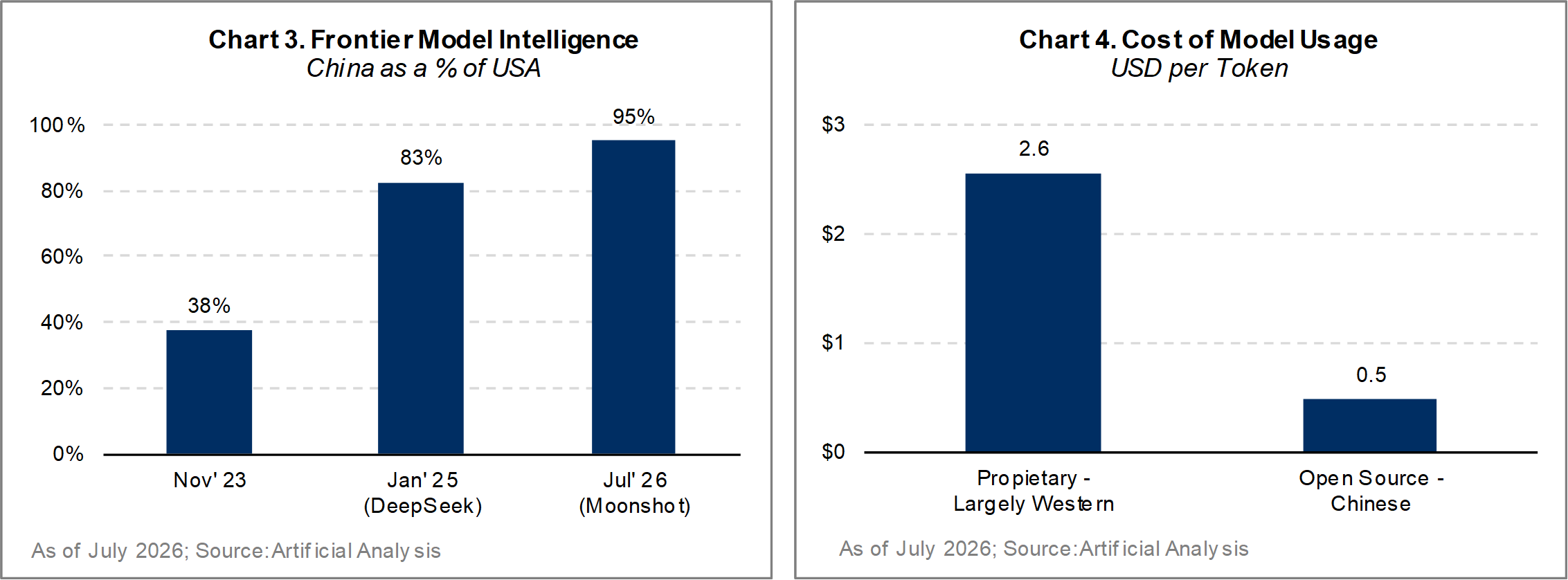
Our local networks crystallized the theme that Chinese pride in AI developments is no longer aspirational but rather backed by data. China’s frontier models have reached roughly 90% of the intelligence of top US models (Chart 3) at prices below 20% of those models’ prices (Chart 4). Critically, this is not subsidized. Gross margins6 of 20–40% match Western peers, reflecting structural training and inference efficiency.
On-the-ground conversations also pointed to accelerating Chinese semiconductor self-sufficiency. BYD is shifting from NVIDIA autonomous driving chips to domestic and in-house alternatives, and AI inference workloads are migrating to domestic silicon. Local memory vendors CXMT and YMTC are closing the gap with global players in both technology and capacity within the high-bandwidth memory space, as they did in commoditized memory previously. CXMT now builds cleanrooms7 in 12 months, about half the industry standard.8
And finally, the research pipeline supports the broader case that this is a story of genuine capability and substantive advantages, not just low prices. China leads in AI publication totals,9 and most models are now open source, which further lowers usage costs. This pattern echoes past Chinese industrial successes. In smartphones and consumer electronics, Chinese firms gained share by offering comparable quality at lower prices. In EVs, they went further, competing on both superior performance and price. China’s AI models today look more like the first pattern – strong value, not yet clear outperformance – but the trajectory bears watching, as they seem to be quickly approaching the EV version of the story.
In the current competitive environment, we are more focused on the expected beneficiaries of these Chinese AI developments – downstream businesses and industries that can take advantage of better models and pricing to improve their operations – than on the AI enablers competing to develop the best models at any cost.
Closing Thoughts: The Red Queen Has Changed Stride
China is transitioning from building scale to exploiting it. In electric vehicles, China is the global low-cost provider and dominates the category. Robotics has dense deployment, applications, and data that no new competitor can easily replicate in the short term. In frontier LLMs, an area where China was assumed to be structurally behind, the gap has narrowed faster than many expected. Even in the consumer landscape, where macro conditions remain fragile, lived experience is increasingly shaped by technology. China tech is not a separate sector story but rather the operating system reshaping behaviors, efficiency, and returns. Our conclusion is that China’s edge is no longer scale – it is process knowledge turning into measurable advantage.
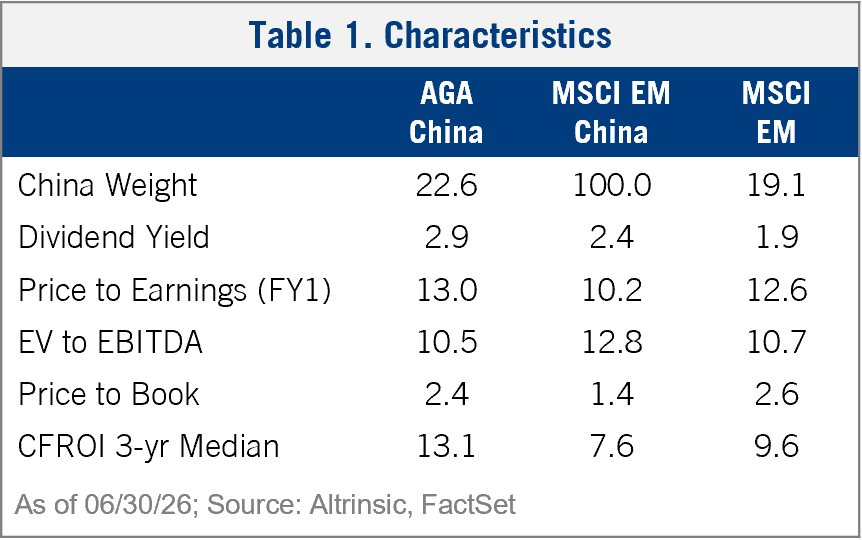
Index flows have chased semiconductors in South Korea and Taiwan, inflating their weight in the MSCI EM Index beyond the level we currently believe reflects the underlying opportunity set, based on a bottom-up assessment. China, by contrast, remains underrepresented relative to the quality of companies we are finding on the ground. Our overweight positioning (Table 1) reflects both bottom-up conviction in specific companies and a benchmark that has grown increasingly narrow – and this differentiation has been a key driver of performance. Process and curiosity have taken us both downstream to robotics and upstream to frontier AI models, and our focus on cash flow leads us to companies at the intersection of technology and financial productivity. Roughly one-third of our China exposure is linked to applied AI and international leadership; Lenovo and BYD are two of the best examples in our portfolio.
Epilogue
Well done is better than well said.
– Benjamin Franklin
The irony is not lost on us – an American founding father’s maxim now reads like a description of China’s technological progress. Fervent, but quiet. The pride we encountered on this trip was obvious but not always overt, as the work speaks for itself. It lives on production floors, in falling bills of materials, and in models priced at a fraction of their peers. Our aim is to own the businesses doing the “well-done” part – quality that is still underappreciated, and therefore not yet priced in.
As we go to print, Moonshot, a leading Chinese AI company, released a model that rocked markets. In Shanghai, President Xi pledged10 open-source models for the Global South, urging that AI must remain “secure and controllable,” with no country’s security placed above another’s. This is another nod to the EM decoupling story we have been describing for years and an invitation for more EM countries to rely on China’s technology stack, including their cheaper frontier models. The move is similar to the One Belt One Road initiative,11 but this time in software rather than infrastructure.